Three sovereignties, and the one we keep forgetting

Dear readers, we talk about sovereignty as if it were one thing — a flag, a firewall, a law. It isn't. It's three, and the one we keep forgetting is the smallest but the most important of them all.
Why the future of medicine and open science depends on the smallest layer of them all
"Sovereignty" has become the most expensive word in European health policy. It justifies billion-euro programs, fills strategy papers, and opens every conference keynote. But sit at three different tables (a health ministry, a hospital board, a night shift) and the word changes shape each time. I have sat at all three over the years, and I keep running into the same confusion: we argue about sovereignty as if it were one thing. It is at least three. And the layer that will decide the future of medicine, and of science itself, is the one getting the least attention and almost none of the money.
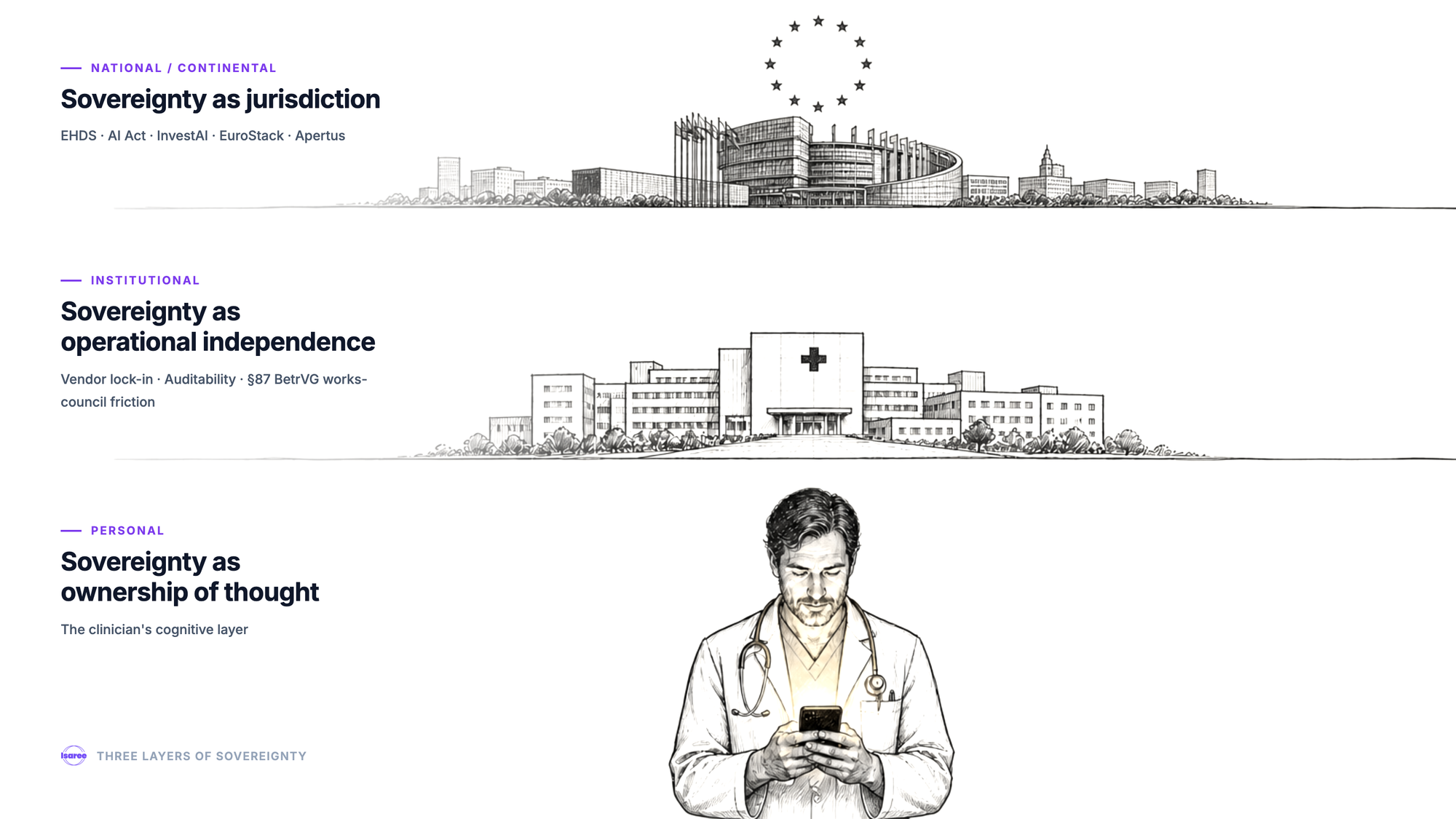
The view from the ministry:
sovereignty as jurisdiction
For national health systems, sovereignty is about borders and law. Whose jurisdiction covers patient data? Could a foreign government subpoena it? The US CLOUD Act says yes, at least for US-controlled providers, wherever the server physically sits. Would our hospitals keep running if a trade dispute escalated into a tech dispute?
Europe's answer so far has been regulatory and industrial. The European Health Data Space has been in force since March 2025. The AI Act is phasing in. The AI Continent Action Plan and the InvestAI initiative want to mobilize €200 billion, gigafactories included. EuroStack builds on what Gaia-X started. Switzerland released its open-weight Apertus model a year ago this week. The unit of analysis is the state. The instruments are law, subsidy, and procurement. The metric is data residency and domestic compute.
This work matters. I have advised governments on exactly these questions, and I don't dismiss any of it. But it is a blunt instrument, and we should be honest about what it cannot do. A country can tick every continental sovereignty box, European cloud, European model, European data space, while nothing changes inside its hospitals.
The view from the hospital:
sovereignty as operational independence
Ask a hospital director or CIO what sovereignty means and you rarely hear geopolitics. You hear: can we still run this place if the vendor triples the price, sunsets the product, gets acquired, or swaps the model overnight? Can we inspect what the AI does well enough to defend it in front of our works council, our data protection officer, and, under the AI Act, a regulator?
By that standard, most European hospitals have close to zero institutional sovereignty. Their electronic health records come from a handful of vendors under decade-long contracts. Their "AI strategy" is often a bundle of per-seat subscriptions to systems they cannot audit, running on infrastructure they do not control, under terms that can change unilaterally.
In Germany, co-determination law (§87 BetrVG) can hold up a cloud-based tool for months or years, precisely because a system that phones home is also a system that could monitor staff. The legal friction is a symptom. The institution cannot verify what it cannot see.
Data residency is not operational independence. You can store every byte in Frankfurt and still rent your clinical cognition from California.
The view from the night shift:
sovereignty as ownership of thought
Then there is the layer almost nobody designs for: the individual clinician.
This is the person the entire regulatory edifice points at and calls "the human in the loop." Final responsibility, legal and moral, sits with them. Meanwhile the tools they actually get are so poor that they route around them. The AMA's surveys show how fast this moved: 66% of US physicians used health AI in 2024; by 2026 it was over 80%. European data is patchier, but walk any ward and you will find the shadow version: a personal account, a consumer chatbot, a discharge summary drafted at 23:00 on a private phone. Clinicians are not doing this because they are careless. They do it because the institution offered them nothing, and the work still has to get done.
The policy response so far has been prohibition and scolding. It will not work, because it misreads what is happening. This is not an IT compliance problem. It is the start of a fight over who controls the instruments of thought in medicine.
Think about what a cloud AI subscription means for a professional mind. Your differential, your literature search, your documentation, your patient letters, all increasingly mediated by a vendor's terms of service. Your usage patterns teach them the product to sell back to you. Your dependence is their moat. And the tool can be repriced, degraded, or withdrawn overnight, lawfully, per contract or per tariffs.
Cognitive sovereignty is the alternative: the tools you think with run under your control. On your device. Open weights you can inspect. Adaptations you can make yourself, for your specialty, your patients, your language. The stethoscope never needed a subscription, never phoned home, and kept working in a blackout. The most important instrument of the coming decades should meet the same standard.
A case study from this week: Epic meets OpenAI
This isn't hypothetical. On 1 September 2026, OpenAI announced that ChatGPT for Healthcare now connects directly into Epic, the electronic health record that holds the charts of more than 325 million patients. Clinicians at institutions like Stanford Medicine, UCSF, Boston Children's, and Cedars-Sinai can query a patient's notes, labs, and medications in natural language, right inside the record.
It is, by every conventional measure, a good product. It will save real time and probably some lives. And it is a near-perfect illustration of how sovereignty gets handed over at all three levels at once, politely, and with a signed contract.
I want to be precise here, because the easy version of this critique is also the lazy one. The deal is not a data grab. OpenAI states it does not train its models on this clinical data. The integration is read-only. It runs under a HIPAA Business Associate Agreement, behind role-based access and audit logs. Every safeguard is in place.
That is exactly the point. Every one of those safeguards is a clause, and the cognition still runs on someone else's computer.
Watch it move through the three layers.
At the personal layer, the clinician's private working thought, the differential they are half-forming, the "wait, could this be…" they type before they would ever say it aloud, now flows through a third party's servers. Not to train a model, we're told, and I believe the intent. But the thought leaves the room. An instrument of thought that must ask permission from a terms-of-service document is not the clinician's instrument, no matter how politely it behaves. The moment the safeguard is a policy instead of a physical fact, the clinician is a guest in their own reasoning.
At the institutional layer, the hospital has placed the most consequential technology of the decade, the thing that increasingly mediates how its doctors think, on infrastructure it cannot inspect, under a safety metric it cannot independently verify, with the legal and reputational liability still landing on its own staff. The institution bought the capability and kept none of the control. That is not sovereignty; it is tenancy with good marketing.
At the national and continental layer, clinical data for hundreds of millions of patients is processed on the cloud of a US-controlled company. Yes, OpenAI offers regional data residency, including in Europe. But residency is where the bytes sit at rest. Jurisdiction follows control, not geography, and the US CLOUD Act reaches data held by US providers wherever the server lives. A European health system can route every request through Frankfurt and still have its clinical cognition governed from San Francisco and reachable from Washington.
Read it again: nothing here failed. The product is excellent, the vendor is acting in good faith, the contract is signed, the compliance boxes are ticked. And sovereignty drained out of all three layers anyway, because none of it was ever encoded in the architecture. It was only ever written into the paperwork. That is the difference between a contract clause and a law of physics, and it is the whole argument.
What open science already figured out
If the personal layer sounds like a luxury, look at what science itself learned the hard way.
For most of modern history, the gate sat between researchers and knowledge: paywalled journals, closed datasets, instruments locked in a few elite labs. Robert Merton called the alternative the communalism of science, the idea that knowledge belongs to the community. The open science movement spent two decades turning that norm into infrastructure, from the Budapest and Berlin declarations to the UNESCO Recommendation on Open Science, adopted by 193 member states in 2021, which explicitly counts open source software and hardware as part of open scientific knowledge.
Openness won for a simple reason. The unit of science is the individual mind. Ideas appear in heads, not in procurement departments. Knowledge compounds when any mind can read, check, and build on the work of any other mind, without permission. Every gate between minds and knowledge slows the whole system. Every gate removed accelerates it in ways no central planner can predict.
Now extend the argument one step, because in 2026 the gate has moved. It no longer sits only between the researcher and the paper. It sits between the thinker and the thinking tool. If the instruments of thought are rented, closed, and remotely steerable, we have rebuilt the paywall one layer deeper, at the level of cognition itself. A researcher with free access to every journal but no sovereignty over the AI she thinks with is like a surgeon with free access to every textbook and a scalpel that phones home for permission.
The hopeful version writes itself. Give clinician-researchers tools they own, and you get what open source has always produced at its best: a thousand local adaptations at the edges, shared back into the commons, compounding. No central lab, however well funded, can out-plan a global community of minds that are free to tinker. Open science flourished when individuals gained access to knowledge. It will flourish again when individuals gain ownership of cognitive tools. That is why personal cognitive sovereignty is not a privacy nicety. It is research policy. It is how we get more ideas, better ideas, faster.
The uncomfortable part: the layers don't agree
Most sovereignty talk gets naive at exactly this point, because the three layers are not allies by default.
National sovereignty can be invoked to centralize health data and build state-run AI that watches everyone: sovereignty for the state, serfdom for the citizen. Institutional sovereignty can mean the hospital owns everything and the clinician owns nothing; the works council wins the battle and the nurse still types the same sentence forty times a day. And personal sovereignty without institutional and national guardrails is just shadow IT with patient data in it.
So the interesting question is not which layer matters most. It is whether an architecture can deliver all three at once.
Very few candidates can. On-device AI built on open-source models is one. Patient data never leaves the clinician's device, which serves the personal layer. The hospital can audit the weights and vouch for the system because nothing is a black box, which serves the institutional layer. And the stack carries no extraterritorial kill switch, which serves the national and continental layer. This is the bet I have made with Isaree, and it is why I keep coming back to the same sentence:
Cognitive sovereignty is an architecture decision, not a contract clause.
The Epic-OpenAI deal is the contract clause. It is a very good contract clause. It will also never be a law of physics. Contracts and regulation can restrain a vendor. They cannot give you back the ability to think with tools you own. Europe is spending billions on sovereignty at the top of the stack, and some of that money is well spent. But sovereignty compounds from the bottom up. Put owned, open, inspectable AI into the hands of every clinician and every researcher, and the upper floors of the building get sturdier on their own. The open science movement won the fight for access to knowledge. The sequel is the fight for ownership of thought. It is winnable, it is cheap compared to gigafactories, and it starts where progress in science has always started, in a single mind free to think with its own tools.