The last unextracted market

Did you see the news? Anthropic is moving into African healthcare. A Goldman Sachs sensitivity table explains the economics of the smile, and my years at IBM Watson taught me how this film ends.
Dear readers,
This week Anthropic opened Claude and its API to the Democratic Republic of Congo, the latest stop in a run that already includes Ethiopia, Rwanda, Burundi, Uganda, Zambia, and the Central African Republic. Just a few days earlier it announced, together with OpenEvidence, free clinical decision support for doctors in roughly one hundred low- and middle-income countries: specialist-level answers built on peer-reviewed literature, delivered on a smartphone. In February this year it signed a three-year agreement with Rwanda covering health, education, and the public sector: cervical cancer elimination, malaria, maternal mortality, Claude Pro licenses for teachers, API credits for government developers. In May it committed $200 million with the Gates Foundation to AI programs in India and Sub-Saharan Africa.
Let’s start by giving credit where it belongs. A young doctor in Kinshasa or Kigali who can query the sum of peer-reviewed medicine from a phone is better off than she was last year. I have spent years arguing that access to medical knowledge is a human right. In 1989 I wrote my "eindwerk", the final thesis every Flemish high school student writes, on exactly this: the idea that artificial intelligence would one day turn doctors in Africa into super doctors. I will not complain when a serious company hands out exactly that.
Instead I will do what 25 years in digital health taught me to do when a gift this size arrives at the gates:
1. read the gift
2. inspect the economics of the giver,
3. inspect the architecture of the gift,
and then ask the question, what remains when the subsidy ends, and what is inside the horse? I have seen this film many times before.
The rooms where generosity gets sold
Regular readers have heard the Watson story; I told it in my last letter and will not repeat it here. The short version matters because of what it cost to learn. I was part of the IBM global healthcare and life sciences team and the team behind Project Voyager, the initiative that led to the Watson Health investments, and later I led IBM's healthcare industry business in Central and Eastern Europe. From inside, I watched a central model, trained with one elite institution, get deployed into hospitals whose formularies, guidelines, and disease mixes it had never seen. We made headlines, but just not the wants you want to see. It recommended treatments that made sense in Manhattan and nowhere else. In LMICs it made recommendation for treatments, the country could not afford.
Hospitals paid and discovered they had bought a tenant, not a capability: their staff was never trained to build anything, their data improved someone else's product, and when the business case collapsed and the division was sold off, the pilot sites kept the dependency and none of the capability.
I carry three lessons from those years.
Lesson one. Nothing comes for free. In health technology, the gift and the invoice arrive in the same envelope, just years apart. The gift is market entry. The invoice is the business model.
Lesson two. Healthcare is local. Guidelines, language, disease mix, literacy, law, and workflows differ from one ward to the next, let alone one continent to the next. A model that is brilliant in Boston can be confidently, fluently wrong in Bishkek or Bukavu. Watson did not fail because the engineers were weak. Some of my colleages belonged to the leading researchers in the field. It failed because a central model cannot absorb a local reality it has never seen, and because nobody priced the local adaptation work. Having managed country versions of SAP's industry health solutions, I can offer a few insights into localization, for those interested.
Lesson three. The model was never the product. The product is the system around the model: local data, local guidelines, interfaces, workflows, evaluation, and a human who remains accountable. Whoever owns that layer owns the value. Everything else is a component.
The sensitivity table behind the smile
Now the document that turned this week from philanthropy into arithmetic.
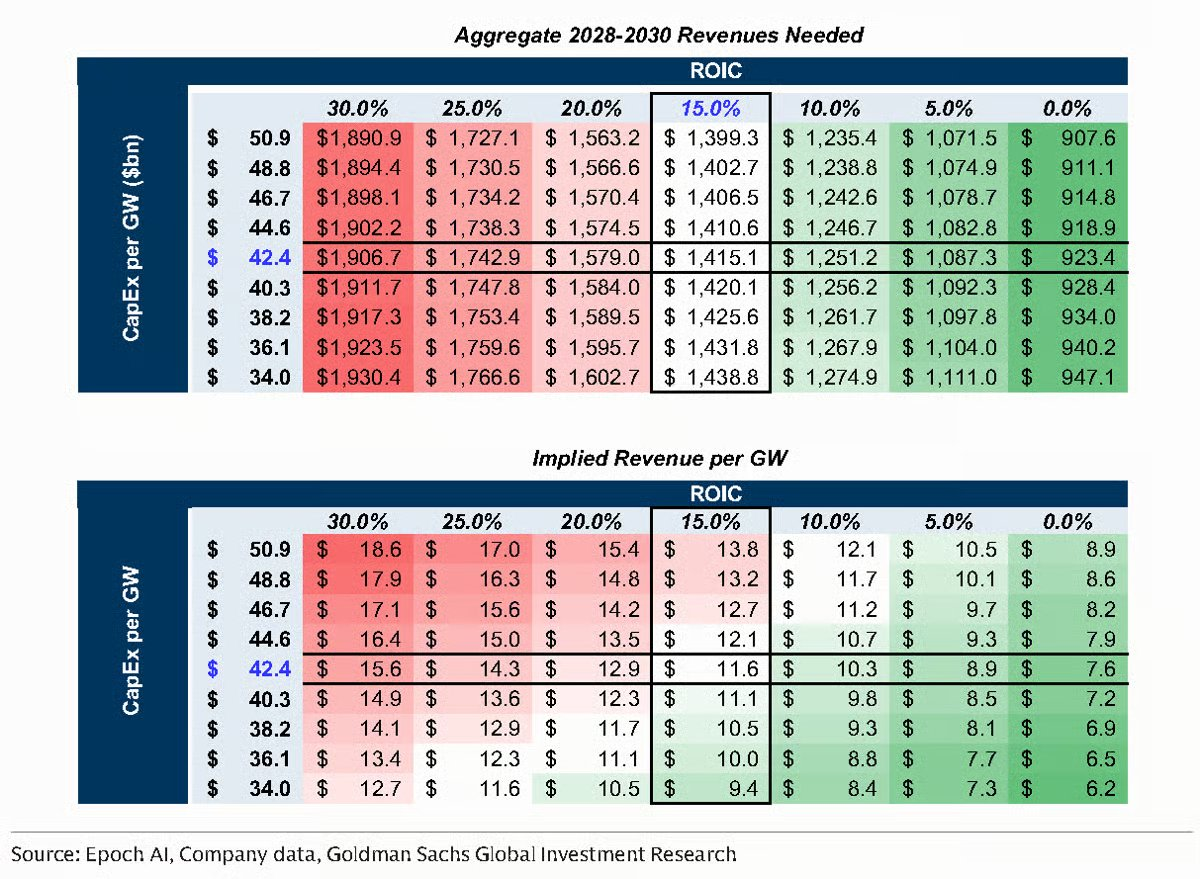
Goldman Sachs recently walked through the hyperscaler buildout: phase one, 2023 to 2025, $633 billion of capex; phase two, 2026 to 2027, $1.73 trillion. The interesting part is the sensitivity table in Goldman's own analysis of the AI build-out: in the case where return on invested capital is zero, because token prices collapse and demand shifts to open models, the hyperscalers still need roughly $920 billion in revenue across 2028 to 2030 just to cover depreciation and running costs. Not to profit. To break even on the concrete. For scale: $920 billion is more than the annual GDP of Belgium, and about a third of what the entire African continent produces in a year. The bill is continental in size, so the hunt for revenue will be continental too. At a 15 percent return, the number rises to $1.42 trillion.
And the zero case is no longer exotic. Mozilla's State of Open Source AI report counts open models at 33 percent of usage and 4 percent of revenue. One mid-2026 snapshot had open source at 51 percent of inference tokens at $0.41 per million tokens, against $10 for Claude. Token price indexes fell hard enough this year that Goldman's own trading desk flagged the pattern: volume up, dollar spend flat.
Anthropic does not own the data centers; it rents them, and its two biggest backers are also two of the biggest landlords in that table. But the rent is owed by someone, and the landlords' sensitivity table tells you what the whole stack must earn. Read it, and the Africa news stops looking like a subplot. If the model layer commoditizes, revenue has to come from somewhere else: applications, verticals, anchor contracts, and new demand pools. African healthcare is the largest under-digitized pool of clinical demand left on earth, and it enters the spreadsheet as growth. The MOUs, the free licenses, the donated API credits: that is what customer acquisition looks like when the customer is a ministry.
I want to be careful here, because this one is personal. A decade ago Ariel Beery has spent more than a decade building MobileODT, turning smartphones into cervical cancer screening devices for clinics in Kenya, where the disease is the number one cause of death among women, and far beyond. So when Rwanda's agreement names cervical cancer elimination as a goal, I do not read a line in a pitch deck. I read Ariel's life work finally getting the institutional backing it always deserved. The need is real, the cause is good, and Anthropic employs sincere people. Precisely for that reason, the architecture matters: nothing travels as smoothly as dependency wrapped in a good cause. A lab whose premium token prices are collapsing needs durable, contractual, hard-to-commoditize revenue, and a free clinical tool for a hundred countries builds the relationships that revenue is later made of.
Extraction, translated into healthcare
I owe the frame for this to Nick Couldry, the LSE sociologist who coined the term data colonialism. Years ago we sat down for a long conversation, Data is Human Life, and I have spent the years since adapting his concept to healthcare. Extraction is a simple mechanism: value flows out, capability does not flow in. The colonial version took raw material and shipped back finished goods at a markup. The digital health version takes clinical interactions, workflow dependence, and hard-currency subscription payments, and ships back a terms-of-service document. These enhancements disappear when the contracts end, there is no portability of service.
Two weeks ago I wrote about the WHO conference in Lisbon, where 37 countries described this without naming the mechanism. Dr. Hans Kluge used Couldry's language directly: data generated in one country creating value in another, without benefit for the people who created it. Dr. Alain Labrique put the operational version in one sentence: a ministry that cannot inspect a model, cannot audit it on its own population, and cannot withdraw it from service does not own that system. It rents it.
Every rented clinical answer is also an import. A health system that runs on API calls imports cognition the way it imports oil: in hard currency, at prices set elsewhere, with supply that can be repriced, degraded, or withdrawn lawfully, per contract. The free tier is not an exemption from that logic. It is the marketing budget of that logic.
The audit happens where the patient is
Here is where regulation quietly agrees with the Watson lesson, and almost nobody in this debate has noticed.
Under the EU AI Act, a general-purpose AI model cannot be certified as a healthcare product. It is general-purpose by definition; the regulated object is the deployed system for a specific intended use. Google's own Health AI Developer Foundations FAQ says the quiet part out loud: the deployer is responsible for local evaluation. Not the lab. Not the foundation model. The deployer, in their own population, against their own guidelines.
That single fact reorganizes the whole sovereignty debate, as the audit that decides whether an AI is safe for a Congolese patient does not happen in San Francisco. It can only happen where the patient is, or it does not happen at all.
And it follows that open models are not applications. Weights are a component. The application is model plus local data, plus retrieval and guidelines, plus interface, plus workflow, plus evaluation, plus human accountability. To its credit, OpenEvidence says it will adapt its system to local disease patterns, infrastructure, and diagnostic resources. Good. That admission is the whole argument: the adaptation layer is the product, and the question is who owns it. Once you see the application as the unit, the governance question inverts. Local governance of an open component you can inspect is more coherent than hoping a distant closed lab is easier to audit. You cannot audit Claude's weights from Kigali. You can audit an open model running on your own machines, in your own language, against your own guidelines.
If the goal is access plus local capability, meaning skills, compute, integration jobs, and fewer imported API bills, then open components plus local applications are the better default. And weights alone are not enough: without power, GPUs, data quality, and trained staff, a downloaded model is a trophy, not a tool. Building that surrounding layer is the actual development work. It is also the work that donation programs conveniently skip.
The mainframe moment
There is a second force underneath all of this, and it is moving faster than the policy debate. AI is repeating the history of computing itself: mainframe first, personal computer second. For two years the frontier lived only in data centers, reachable through a metered API. That phase is ending. Today a machine costing $5,000 runs roughly the frontier capability Anthropic was selling eight months ago, and the hardware market will now do what it always does: push capability to the edge and take the margin out of the center. At Isaree, we have developed an edge-AI medical scribe framework that transcribes four-speaker conversations and extracts key clinical concepts into user-defined templates-running completely on-device on an 8GB iPhone 15. Rather than per-token pricing, our model charges for the underlying infrastructure and compliance framework. Being fully platform-, model-, and agent-agnostic, we ensure that our clients maintain 100% ownership over their data and intelligence.With Isaree, I'm putting my money where my mouth has been for the last eight years. Open capability and complete sovereignty.
A national health AI strategy written around permanent dependence on a rented mainframe will read, in five years, like a 1975 hospital plan built around leased time on someone else's computer.
Free access creates dependency; open components build self-reliance. True development isn't about handouts, it’s about equality of opportunity and sovereignty over your critical infrastructure.
The test
So no, I do not end on cynicism, and I do not end on gratitude. I end on a test, the one I wish someone had applied to Watson in 2011.
Judge every donated AI program in healthcare by what remains when the subsidy ends. For every free license, is a local evaluation lab being funded with the same energy? For every API credit, is there an open-weights fallback the ministry can run itself the day the price changes, or the day a change of political power rewrites the tariffs of your whole healthcare system? Are your policies actively supporting the development and deployment of open-weight models published under truly open-source licenses? Are the exit terms published on day one? In five years, will Kigali and Kinshasa have trained staff, validated local applications, and infrastructure they own, or will they have a life-long dependency and an invoice?
If it is the first, this was development, and I will be the first to applaud it. If it is the second, it was extraction with good branding, and all the cervical cancer language in the world will not change the ledger.
Why I build Isaree
This is why I have been building Isaree: an infrastructure for local AI that at the same time facilitates global collaboration and sharing. A platform where healthcare providers, health systems, and communities own their own models, adapted on their own data, in their own language, and share what works back into a global commons. Local ownership with global exchange, because the opposite of extraction is not isolation, it is trade between equals. The economics of that ownership have flipped. The cost and complexity of adapting a model to your data have collapsed. Aleph Alpha just published what it costs to make a reasoning model think in German instead of translating from English, and the answer was a data recipe, not a moonshot. Alexander Doria, who builds open AI infrastructure at Pleias, named the demand side in one sentence this week: embedding models in real processes requires easy audit, and local language, even the local professional register, removes friction. Medicine is the ultimate professional register. What Aleph Alpha priced for German, a ministry can now price for Swahili clinical notes or francophone triage protocols.
I have seen 25 years of empty promises, and when I left IBM, I have spent the years since building the opposite: open, local, inspectable medical agents that a clinician, a hospital, or a ministry can own outright. The stethoscope never needed a subscription, never phoned home, and kept working in a blackout. The most important medical instrument of the coming decades should meet the same standard, on every continent, and especially on the one the frontier labs just discovered.
Have a great start to the week,
Bart