The Year the Future Arrived

Dear readers,
As 2025 has now closed, I find myself reflecting on a year that validated seven years of conviction. What many in the market experienced as disruption, I saw as confirmation of long-held insights.
The Prediction Becomes Reality In 2018, I made a bold claim: the future of artificial intelligence would not belong to centralized, proprietary models controlled by a handful of tech giants. Instead, it would emerge from open ecosystems of specialized, distributed agents operating on shared principles and open standards. Many dismissed this as idealistic. Some called it naive. The following year, during my TEDx talk in 2019, I emphasized that "open sourcing medical AI could destroy the future AI monopolies.” In February 2025, DeepSeek demonstrated, my assumptions were correct.
An open-weight model from a Chinese startup erased significant market value, estimated at nearly $600 billion, from U.S. Big Tech companies in a single month. This was not unexpected; it was the culmination of trends that had been evident for years. The market finally recognized what was already clear: open-source AI does not merely compete with proprietary models, it outperforms them on key benchmarks.
The Agentic Web Emerges
What made 2025 transformative was not just DeepSeek. It was the emergence of standards like MCP (Model Context Protocol) and A2A (Agent-to-Agent) communication frameworks. These are practical infrastructure elements for a vision I outlined in my chapter in the book Zukunftsrepublik from Marie-Christine Ostermann 5 years ago:“When we look to the future of medical artificial intelligence, we should see it as an ecosystem and network of intelligent agents that interact with each other across a decentralized network according to shared principles and open standards.”This year, that vision transitioned from theory to technical implementation.
Small Models, Big Impact
The most compelling validation came from research papers demonstrating a counterintuitive truth: small models running on personal devices, coordinated by intelligent agents, can outperform massive general-purpose models that require vast data centers.This marks a key inflection point where the paradigm shifts.For years, the prevailing view was that scale was paramount, more parameters, more compute, more reliance on the cloud. 2025 showed that efficiency is superior. An under-10-billion-parameter model operating on-device, supported by specialized agents, can surpass a 100-billion-parameter model in the cloud, while inherently providing privacy, resilience, and sovereignty. Recent advancements have shown models with as few as 2.6 billion parameters outperforming those in the 3-billion-plus class across benchmarks in knowledge, mathematics, instruction following, and reasoning, often with twice the speed on, what I call living room CPUs or consumer grade hardware. While these huge data center capacities might offer utility in the quest towards AGI, for transforming healthcare, decentralized AI capacities provide immense utility. We can build this in a hybrid mode and work over the next five years towards a future that is fully decentralized.
Consider the parallels in technological progress: just as advances in compression and efficiency enabled HD movies to stream seamlessly on smartphones, what once required broadcast infrastructure and physical media, AI is undergoing a similar transformation. Or take digital photography, where sophisticated algorithms now allow pocket-sized devices to capture and process high-resolution images that rival professional equipment, all without the need for film or darkrooms. These examples illustrate how optimization unlocks powerful capabilities in compact forms, and in AI, we're seeing the same: intelligence compressed into efficient, on-device systems that democratize access to advanced tools, drastically reducing costs, enhancing accessibility to life saving medical intelligence in any corner of this planet, and minimizing environmental impact, making this especially transformative for healthcare, where equitable, real-time intelligence can save lives regardless of location or resources.
Why I Co-Founded Isaree
This is why I founded Isaree one year ago, not in response to short-term trends, but as the logical extension of a seven-year vision.We are building the world’s first operating system for agentic AI in healthcare. Not an isolated solution. Not another cloud-reliant platform. An open ecosystem where specialized AI agents, operating on the phones and devices of doctors and nurses, coordinate intelligent workflows focused on patients, rather than rigid systems. Our marketplace is like Spotify for medical intelligence, providing seamless, on-demand access to a vast, curated library of specialized AI agents and tools, personalized to your needs.
We have been focusing on the foundational work, and in 2026 will focus on building the ecosystem with agents that are certified, validated, and decentralized. Our architecture is robust, it functions offline, in crises, and when infrastructure is unavailable. It reflects the principles I have advocated since 2018: open standards, distributed intelligence, and local sovereignty. The Community Hub serves as a foundation for this marketplace.
The Year Ahead 2025 confirmed the thesis.
2026 will focus on implementation. We are launching our Community Hub in Q1, a platform where researchers, developers, and physicians can collaborate to build, share, and deploy specialized AI agents directly on their phone.
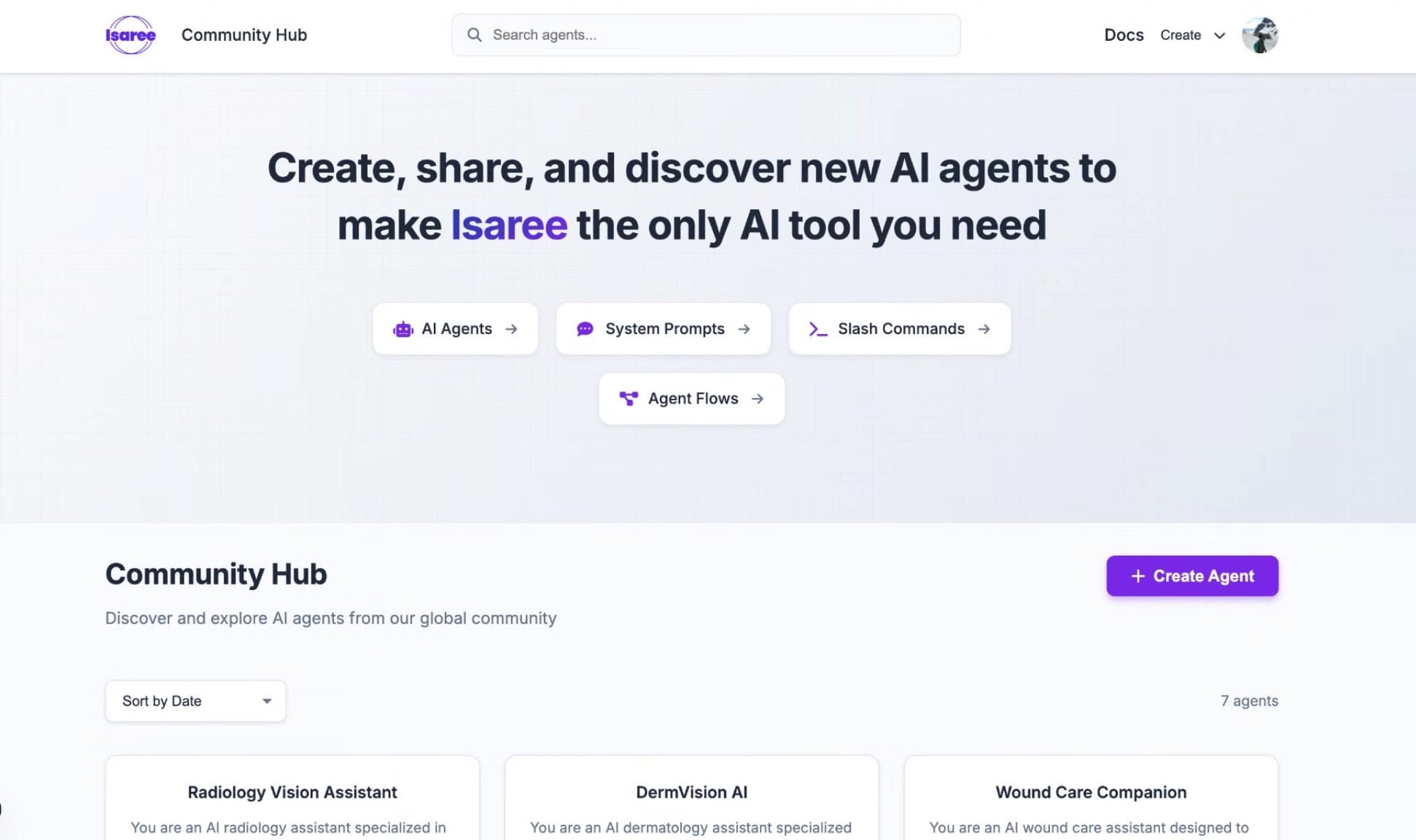
We have secured pivotal global partnerships with key players in the field that we will announce in 2026, unlocking unprecedented opportunities for collaboration and growth, opportunities that are time-sensitive and poised to redefine the landscape for those who act now. We are partnering with leading healthcare providers to show that agentic AI is not a future possibility; it is a practical reality today.
We are establishing Isaree as the European counterpart to emerging U.S. healthcare AI leaders, but with a distinct approach: decentralization rather than consolidation; open standards instead of vendor lock-in; local innovation allowing rapid tech transfers from Europe's great research infrastructure over centralized control. We are building the infrastructure that enables, not controls.Germany, Europe, and the world face a critical choice.
We can persist with centralized, proprietary systems that concentrate power and data among a few tech giants. Or we can develop open ecosystems where intelligence is distributed, innovation arises from diverse sources, and patients and physicians retain control over their data and workflows.I am committed to the latter. And 2025 has shown that this view is increasingly shared.
Thank You To those who supported this vision when it seemed improbable. To those who challenged it and helped refine my perspective. To the team at Isaree building this future daily. To the physicians, researchers, and institutions partnering with us.The future is not inevitable; it is what we create together.Let’s create it.
Warm regards,Bart de Witte
Founder & CEO, Isaree.ai
P.S. If you are interested in joining this journey, whether as a partner, investor, or collaborator, please reach out. The opportunity to advance European AI sovereignty is here. Let’s seize it.