The Evolutionary Leap: From Headless EHRs to the Agentic Web of Healthcare

Hello from Berlin. In my previous newsletters, I’ve discussed the "technical-legal integration paradox" and the slow death of traditional EMR interfaces. Today, I want to explore the next architectural leap that is quietly reshaping healthcare IT: the transition from Headless EHRs to fully Agentic Healthcare Systems.
Let me share a personal experience from my time as a product manager at SAP back in 2006. We were working with BAPI APIs, trying to decouple complex backend systems from the user interfaces so that different departments could build custom views without breaking the core logic. It was revolutionary at the time. We called it "decoupling." Today, the healthcare industry calls it a "Headless EHR."
But here is what nobody talks about: decoupling the frontend from the backend is only half the battle. A headless architecture gives you a beautiful, customized steering wheel, but it still requires a human to drive the car.
What happens when the car can drive itself?
We are standing at the precipice of a 180-degree shift in healthcare technology, a shift from systems that wait for human input to systems that anticipate human intent. This is the leap from Headless EHRs to Agentic Healthcare Systems.
The Stepping Stone: Why Headless EHRs Matter
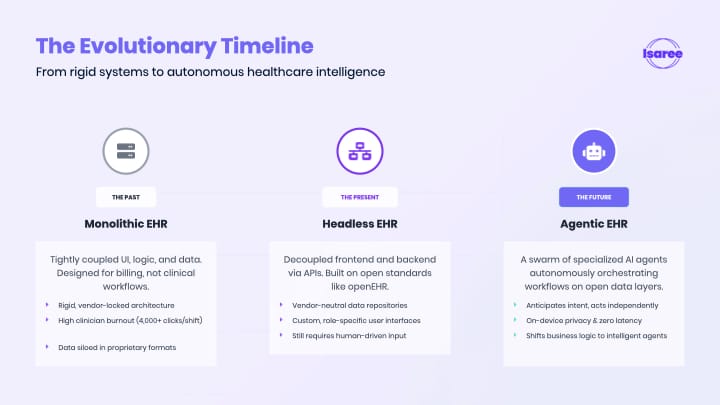
Before we look to the future, we must understand the present. The traditional monolithic Electronic Medical Record (EMR) is a tightly coupled nightmare. The user interface, the business logic, and the database are fused together like a block of concrete. If you want to change a simple workflow for an oncology nurse, you risk breaking the billing system for the entire hospital.
This monolithic architecture is a primary driver of the burnout epidemic. We turned highly trained doctors into the most expensive data entry clerks in history, forcing them to click up to 4,000 times a shift just to document care.
The market's response to this crisis has been the "Headless EHR." Built on open standards like openEHR and FHIR, a headless architecture separates the backend data storage from the frontend presentation layer via APIs . This allows hospitals to build role-specific, custom user interfaces. An orthopedic surgeon gets a different screen than a pediatric nurse, yet both pull from the same central, vendor-neutral data repository.
We are already seeing this architectural shift deliver massive scale and interoperability across Europe.
In Sweden, Karolinska University Hospital recently selected the Better platform to build a core data repository based on openEHR. By standardizing patient data outside of proprietary vendor silos, they are enabling both tailored clinical applications and frictionless data reuse for medical research.
Similarly, the University Hospital Basel in Switzerland is adopting a "Postmodern EHR" approach. Working with a consortium led by OWT, they are building a next-generation, modular data platform on openEHR standards. Instead of buying a monolithic system, they are creating an open innovation ecosystem where startups and developers can build specialized clinical data capture tools directly on top of the hospital's data layer.
But perhaps the most ambitious example is happening in Catalonia, Spain. The region is undertaking the first European open data digital health project of its scale, migrating over 13 million Electronic Health Records into a unified, openEHR-based Health Intelligence Platform (HIP) provided by vitagroup [5]. With over 800 million clinical compositions already processed, this infrastructure will connect 29 different Hospital Information Systems across a population of 8 million. It is a masterclass in breaking down data graveyards to build a unified Electronic Patient Archive .
These headless, openEHR implementations are vital. They provide the necessary vendor-neutral data layer. But let me be clear: Headless EHRs are a stepping stone, not the destination.
Why? Because a headless EHR still relies on a human-driven paradigm. The system sits idle until a clinician clicks a button, types a note, or searches for a lab result. It is a more flexible tool, but it is still just a tool.
The Paradigm Shift: Enter the Agentic EHR
Let me paint a picture of what is coming. Imagine it is 2:00 AM in the ICU. A patient’s vitals begin to subtly degrade.
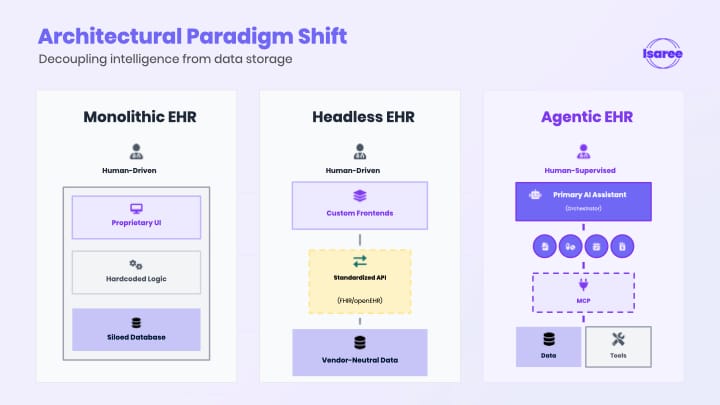
In a monolithic or headless EHR system, the data is logged, an alarm might sound, and the system waits for a tired nurse to rush in, review the charts, and make a decision.
In an Agentic Healthcare System, a specialized AI agent detects the anomaly. It instantly cross-references the patient’s genetic profile, recent lab results, and real-time continuous monitoring data. It identifies a potential sepsis onset. But it doesn't just sound an alarm. It orchestrates a response. It alerts the on-call physician with a synthesized summary of the critical data, drafts preliminary orders for review, and checks the pharmacy inventory for the required antibiotics.
This is the difference between a tool and a teammate.
Agentic AI refers to a class of autonomous systems capable of acting independently toward defined objectives. While generative AI primarily responds to prompts, agentic AI sequences tasks, independently responds to changing conditions, and orchestrates complex workflows across multiple systems [9].
According to recent data from Deloitte, over 80% of health system executives expect agentic AI to deliver moderate-to-significant value across clinical and business functions by 2026, with 98% expecting at least 10% cost savings [9]. The market is waking up.
The Agentic Web: An Ecosystem, Not a Monolith
My core strategic belief is that the future of healthcare AI is not a single, all-knowing, centralized oracle. The future is an ecosystem of millions of specialized, certified AI agents. I call this "The Agentic Web."
Think of AI as a compression algorithm for applicable knowledge. Just as Germany's Fraunhofer Institute invented the MP3 algorithm but failed to build the platform to monetize it (leaving that to Spotify), the healthcare industry must not just build algorithms—we must build the platforms and open standards that allow them to flourish.
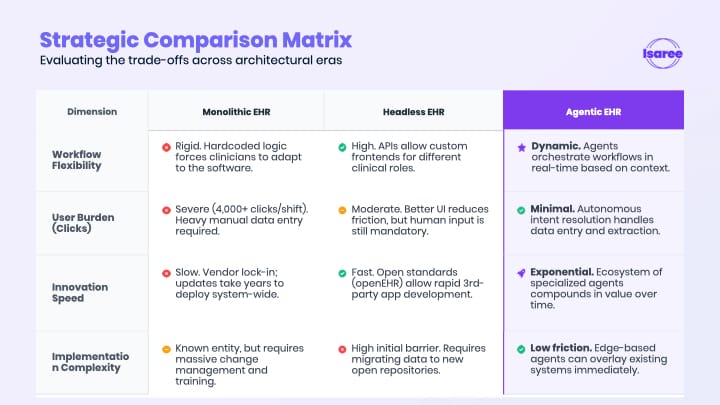
In the Agentic Web, an ecosystem of specialized agents works in a swarm. You will have a clinical documentation agent, a billing agent, a trial-matching agent, and a safety-monitoring agent. These agents will interact with the headless openEHR platforms—like those being built in Catalonia and Basel—autonomously, bypassing the human interface entirely.
This fundamentally changes the economics of healthcare IT.
The Hardware Revolution and the Edge
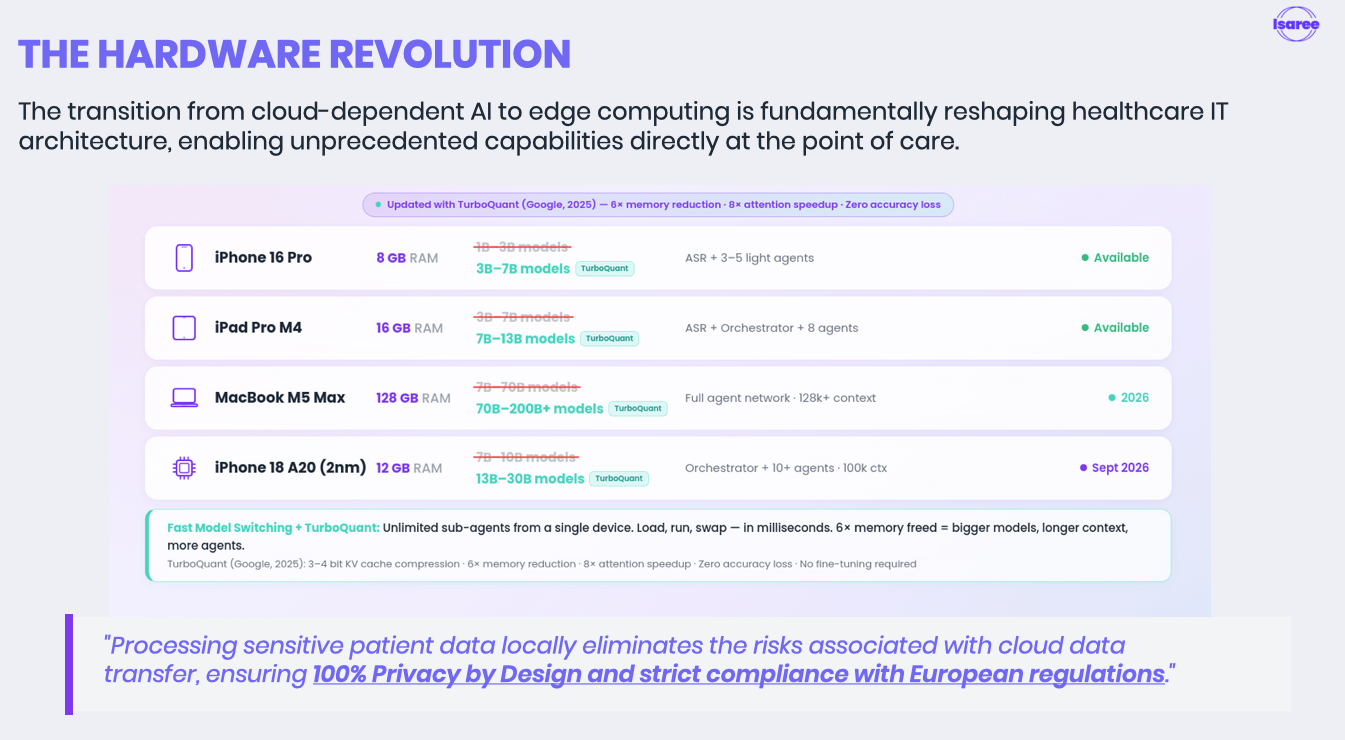
This agentic future is being accelerated by a hardware revolution that few are paying attention to. The introduction of 2nm chip technology means that within five years, we will be able to run massive, 10-billion parameter Large Language Models directly on a mobile phone.
This is a 180-degree switch for the AI market. By moving inference from the cloud to the edge (the device), we break the linear relationship between AI growth and compute costs. It enables maximum privacy, zero latency, and the economic viability of freemium business models in healthcare AI.
Building the Infrastructure Today
At Isaree, we are not just theorizing about this transition; we are building the "Spotify of medical AI."
Our approach starts with an Intelligent Edge Foundation, deploying privacy-first, on-device AI assistants that integrate directly into clinician workflows. We are slowly opening our Community Hub with a selected group of clinicians, releasing over 100 medical language models. We believe strongly that the physicians of the future must be both users and creators of AI. They will build specialized agents that run on-device, offering maximum privacy and control.
These agents will interact directly with the APIs of headless openEHR platforms, shifting the business logic away from the EMR vendors and into an open, certified ecosystem. This is how we dismantle the monolithic data graveyards and build a real-time learning health system.
The transition from Headless EHRs to Agentic Systems is not just a technology upgrade. It is a fundamental rewiring of how care is delivered, documented, and coordinated. The open data platforms being built today in Sweden, Switzerland, and Spain are laying the tracks. The AI agents are the high-speed trains that will run on them.
The technology is here. The hardware is ready. The only question is: are we ready to let go of the steering wheel?
If you are interested in following our work at Isaree and getting access to our free agent builder platform and assistant -> register here to join the waitinglist and get early access
Happy Easter,
Bart